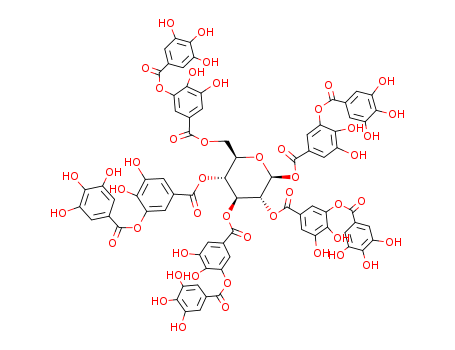
- CasNo 5424-20-4
- Purity 99%

Location:Home > Pharmaceutical
High quality purity >99% TANNIC ACID 5424-20-4 for sale We provide high quality TANNIC ACID (CAS 5424-20-4), at a very affordable prices to our customers.
1.What is the TANNIC ACID ?
Gallotannin is a polyphenol of gallic acid that has been found in various plants and has antioxidant, anti-inflammatory, antiviral, and antiproliferative biological activities. Gallotannin (1 μM) inhibits the intracellular production of reactive oxygen species (ROS) and DNA damage induced by phorbol 12-myristate 13-acetate (TPA; ) in human polymorphonuclear neutrophils (PMNs). It also decreases TPA-induced nitric oxide release by 90% from primary rat hepatocytes when used at a concentration of 0.5 mM. Gallotannin inhibits hepatitis C virus (HCV) entry into Huh7.5 human hepatoma cells (IC50 = 5.8 μM) and inhibits the proliferation of MDA-MB-231 and MCF-7 human breast cancer cells (IC50s = 2.5 and 4 μM, respectively). In a rat model of middle cerebral artery occlusion (MCAO), it increases superoxide dismutase (SOD1) protein levels and decreases the amount of proteins modified by malondialdehyde (MDA) in ischemic brain tissue when administered at a dose of 10 mg/kg.
Used in Anticancer Applications:
Tannic Acid is used as an anticancer agent for its ability to modulate several oncological signaling pathways, including JAK/STAT, RAS/RAF/mTOR, TGF-β1/TGF-β1R, VEGF/VEGFR, and CXCL12/CXCR4 axes. It exerts inhibitory effects on tumor growth and progression, particularly against solid malignancies such as liver, breast, lung, pancreatic, colorectal, and ovarian cancers. Additionally, Tannic Acid demonstrates synergistic anticancer effects when combined with conventional chemotherapeutic drugs, enhancing chemo-sensitivity and efficacy in resistant cases.
Used in Drug Delivery Systems:
Tannic Acid is used in the development of novel drug delivery systems to enhance its applications and efficacy against cancer cells. Various organic and metallic nanoparticles have been employed as carriers for Tannic Acid delivery, aiming to improve its delivery, bioavailability, and therapeutic outcomes.
Used in Tanning Industry:
Tannic Acid is used as a tanning agent for tanning animal skins to make leather. It is also used as a mordant in dyeing, providing a means to bond dye to fabric more effectively.
Used in Leather Production:
Tannic Acid is used in the production of leather, where it helps in the tanning process by causing the skin to contract and harden, making it more durable and resistant to decay.
Used in Ink and Dye Production:
Tannic Acid is used in the production of inks and dyes, particularly for making dyes and inks from plant sources. It serves as a mordant, which helps to bond the dye to the fabric more effectively.
2.What is the CAS number for TANNIC ACID ?
The CAS number of TANNIC ACID is 5424-20-4.
More information of TANNIC ACID 5424-20-4 are:
|
CAS?Number |
5424-20-4 |
|
Density |
2.129 g/cm3 |
|
Melting Point |
218 °C(lit.) |
|
Boiling Point |
198oC |
|
Flash Point |
198 °C |
|
Refractive Index |
1.927 |
|
HS CODE |
3201909000 |
|
PSA |
777.98000 |
|
LogP |
4.83810 |
|
Pka |
6.00±0.50(Predicted) |
3.What is the molecular formula of TANNIC ACID ?
The chemical formula of?TANNIC ACID is C76H52O46 which containing 76 Carbon atoms,52 Hydrogen atoms and 46 Oxygen atoms,and the molecular weight, and the molecular weight of TANNIC ACID is 1701.22
4.What is TANNIC ACID(5424-20-4)used for?
Gallotannin is a polyphenol of gallic acid that has been found in various plants and has antioxidant, anti-inflammatory, antiviral, and antiproliferative biological activities. Gallotannin (1 μM) inhibits the intracellular production of reactive oxygen species (ROS) and DNA damage induced by phorbol 12-myristate 13-acetate (TPA; ) in human polymorphonuclear neutrophils (PMNs). It also decreases TPA-induced nitric oxide release by 90% from primary rat hepatocytes when used at a concentration of 0.5 mM. Gallotannin inhibits hepatitis C virus (HCV) entry into Huh7.5 human hepatoma cells (IC50 = 5.8 μM) and inhibits the proliferation of MDA-MB-231 and MCF-7 human breast cancer cells (IC50s = 2.5 and 4 μM, respectively). In a rat model of middle cerebral artery occlusion (MCAO), it increases superoxide dismutase (SOD1) protein levels and decreases the amount of proteins modified by malondialdehyde (MDA) in ischemic brain tissue when administered at a dose of 10 mg/kg.
InChI:InChI=1/C76H52O46/c77-32-1-22(2-33(78)53(32)92)67(103)113-47-16-27(11-42(87)58(47)97)66(102)112-21-52-63(119-72(108)28-12-43(88)59(98)48(17-28)114-68(104)23-3-34(79)54(93)35(80)4-23)64(120-73(109)29-13-44(89)60(99)49(18-29)115-69(105)24-5-36(81)55(94)37(82)6-24)65(121-74(110)30-14-45(90)61(100)50(19-30)116-70(106)25-7-38(83)56(95)39(84)8-25)76(118-52)122-75(111)31-15-46(91)62(101)51(20-31)117-71(107)26-9-40(85)57(96)41(86)10-26/h1-20,52,63-65,76-101H,21H2/t52-,63-,64+,65-,76+/m1/s1
Relevant articles related to TANNIC ACID:
|
Article |
Source |
|
Complexating systems, intermediates for their production and method for obtaining and using the same |
- , (2008/06/13) |
5.High quality purity >99% TANNIC ACID 5424-20-4 for sale
jiangyin jiazhou international trade co.,ltd is a quality supplier of TANNIC ACID. Our main goal is customer satisfaction. Contact us to negotiate the best price for your business on TANNIC ACID 5424-20-4.
RELATED PRODUCTS

WANT TO PURCHASE
Please contact us and we will reply to you as soon as possible.